Nanofat & structural fat grafting
Your own fat, from a single harvest, used two ways — emulsified to change the quality of the skin above it, or left intact to restore volume beneath it.
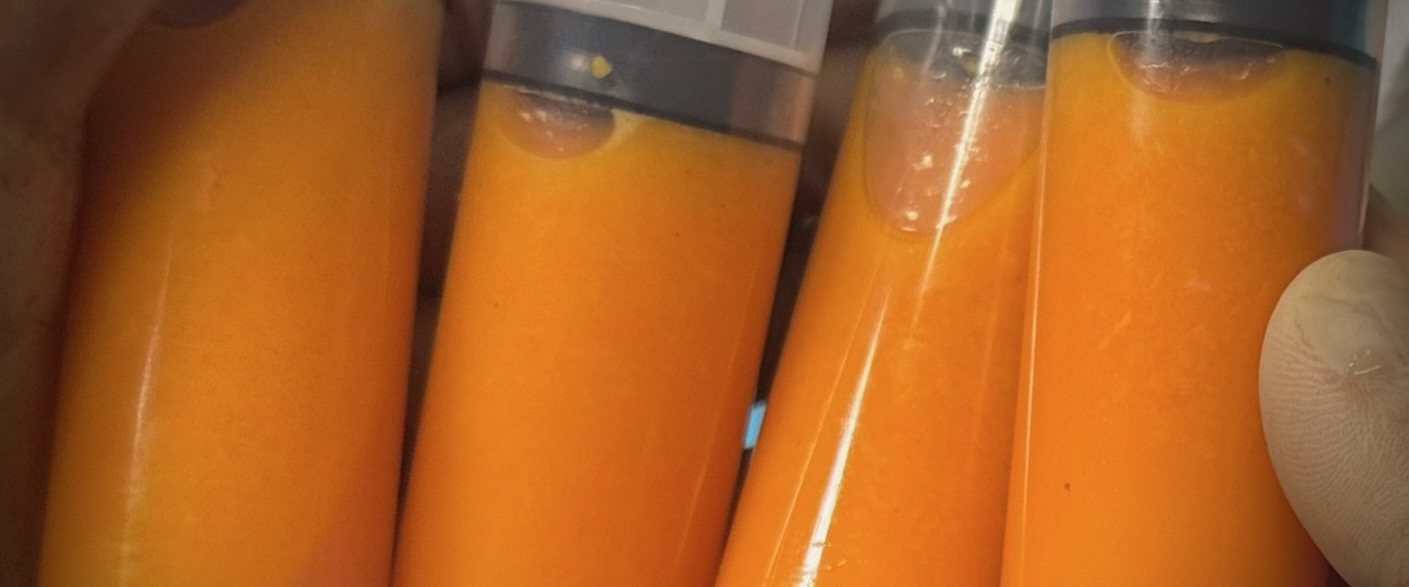
Fat is harvested from the abdomen or thigh through a small cannula, then mechanically emulsified — passed back and forth between syringes and filtered — until the fat cells themselves are broken down. What is left is a thin fluid containing the stromal vascular fraction: the regenerative cell population that lives among fat cells rather than the fat cells themselves.
Because it holds no intact adipocytes, nanofat does not add volume and is not a filler. It is placed superficially, in the dermis and just beneath it, where the intention is to influence skin quality — fine crepey texture, discolouration under the eyes, the surface of a mature scar. Where volume is the goal rather than surface quality, structural fat grafting is the companion technique, described below.
The technique was described by Dr. Patrick Tonnard and Dr. Alexis Verpaele, whose aesthetic fellowship Dr. Cruz completed from March to June 2025, training with them in Ghent and at E:MC2 in Sint-Martens-Latem, Belgium.
A candid note on evidence: nanofat is well established in surgical practice and has a coherent biological rationale, but the published outcome data is smaller and shorter-term than for long-standing procedures. Results vary between people, and the degree of change is generally subtle rather than dramatic. Any surgeon who promises you a specific result from it is overstating what is known.
Where nanofat changes the surface, structural fat grafting restores what is underneath it. Fat is harvested the same way, but instead of being emulsified down to a fluid, it is left intact and transferred in small parcels to areas that have lost volume — the face, or a contour altered by prior surgery or reconstruction. Because the fat cells survive the transfer, a portion of the graft persists long-term, unlike a dermal filler.
The two procedures share a donor site and are often performed in the same sitting: intact fat placed at depth for volume, nanofat placed superficially for skin quality, from one harvest.
Both techniques, described in Ghent
Nanofat grafting was developed and published by Dr. Patrick Tonnard and Dr. Alexis Verpaele; structural fat grafting was part of the same fellowship curriculum. Dr. Cruz trained under both, March to June 2025, in Ghent and at E:MC2 in Sint-Martens-Latem, Belgium.
How it runs
Candidacy for either procedure is determined at an in-person consultation, where anaesthesia, duration and recovery specifics are prescribed on a case-to-case basis.