The MACS facelift
Minimal Access Cranial Suspension — a short-scar technique that lifts the deeper tissues of the face vertically, in the direction they actually descend.
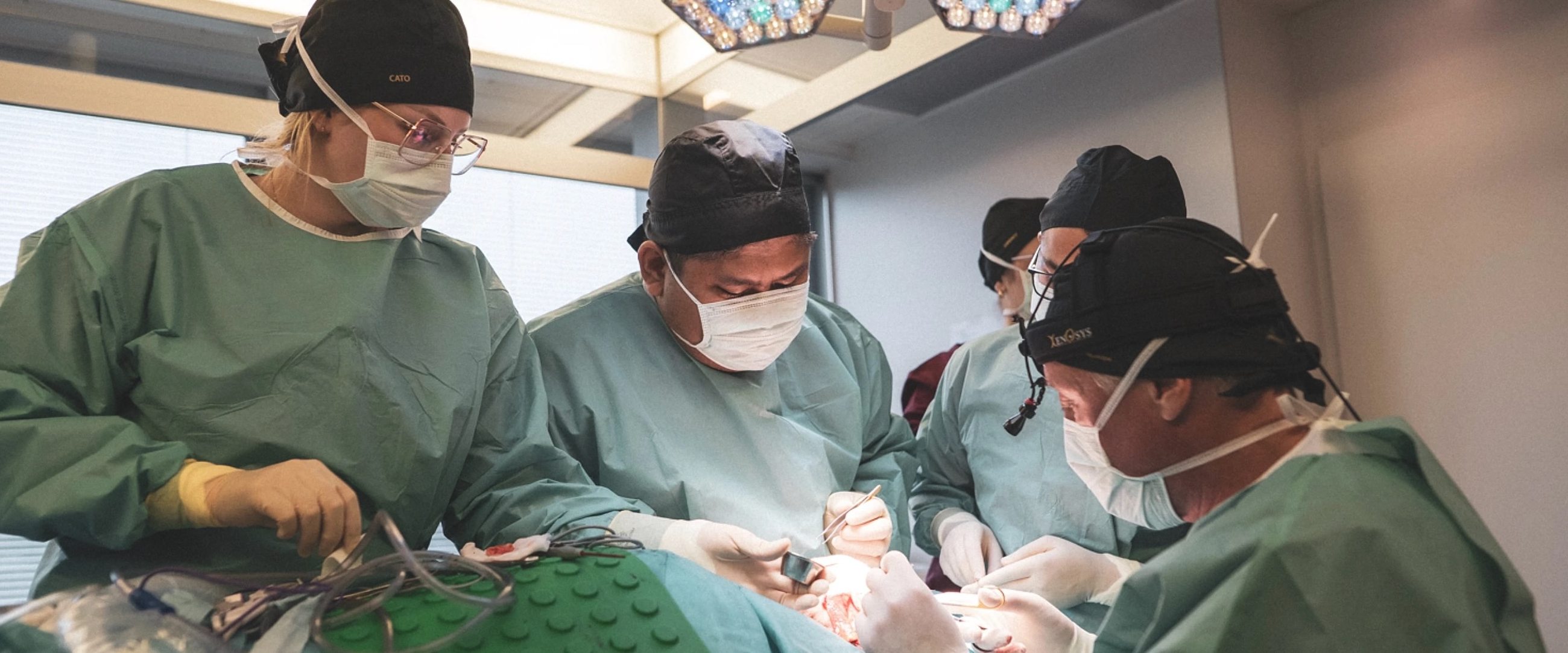
Rather than pulling skin, the MACS lift uses purse-string suspension sutures anchored to the firm fascia above the ear to reposition descended tissue of the midface, jawline and neck. Because the vector is vertical rather than backwards, the result tends to read as the face restored rather than tightened.
The incision stays largely in front of the ear and is shorter than that of a conventional facelift, and the dissection is less extensive. Candidacy still depends on the degree and pattern of laxity in an individual face — it is not the right operation for everyone, and that is a judgement made in person.
Learned from the surgeons who developed it
The MACS technique was developed by Dr. Patrick Tonnard and Dr. Alexis Verpaele. Dr. Cruz trained under both of them directly during his aesthetic plastic surgery fellowship, March to June 2025, in Ghent and at E:MC2 in Sint-Martens-Latem, Belgium.
A MACS lift addresses descent; it does not replace lost volume or resurface the skin, so it is frequently paired with other technique rather than performed alone. Common combinations include a deep neck lift or submental reduction where laxity extends into the neck, and lipofilling or nanofat microneedling to restore volume and skin quality in the same session. Which combination applies, if any, is judged against the individual face at consultation.
How it runs
Candidacy for any procedure is determined at an in-person consultation, where anaesthesia, duration and recovery specifics are prescribed on a case-to-case basis. Not every procedure suits every patient.